Authority
A-Levels
Multiple private companies including Pearson Edexcel, Cambridge and OxfordAQA Examinations.
SACE
SACE Board of South Australia, a South Australian Government agency.
A comparison of the South Australian Certificate of Education (SACE) and A-Levels, so you can see how the Australian School pathway is accredited, taught, and assessed.

SACE has been developed and certified by the SACE Board – a South Australian government agency.
The SACE curriculum meets Australia's extremely high academic standards, which have been recognised internationally for decades. The SACE is part of a teaching heritage stretching back to 1874.
SACE has also been taught with great success across the Asia Pacific region for more than 40 years.
SACE is a pathway to universities globally, with graduates accepted into top-tier universities across the world. There are no limits on where SACE can take you!
The following information will help you assess your options and make an informed decision about which program suits you best.
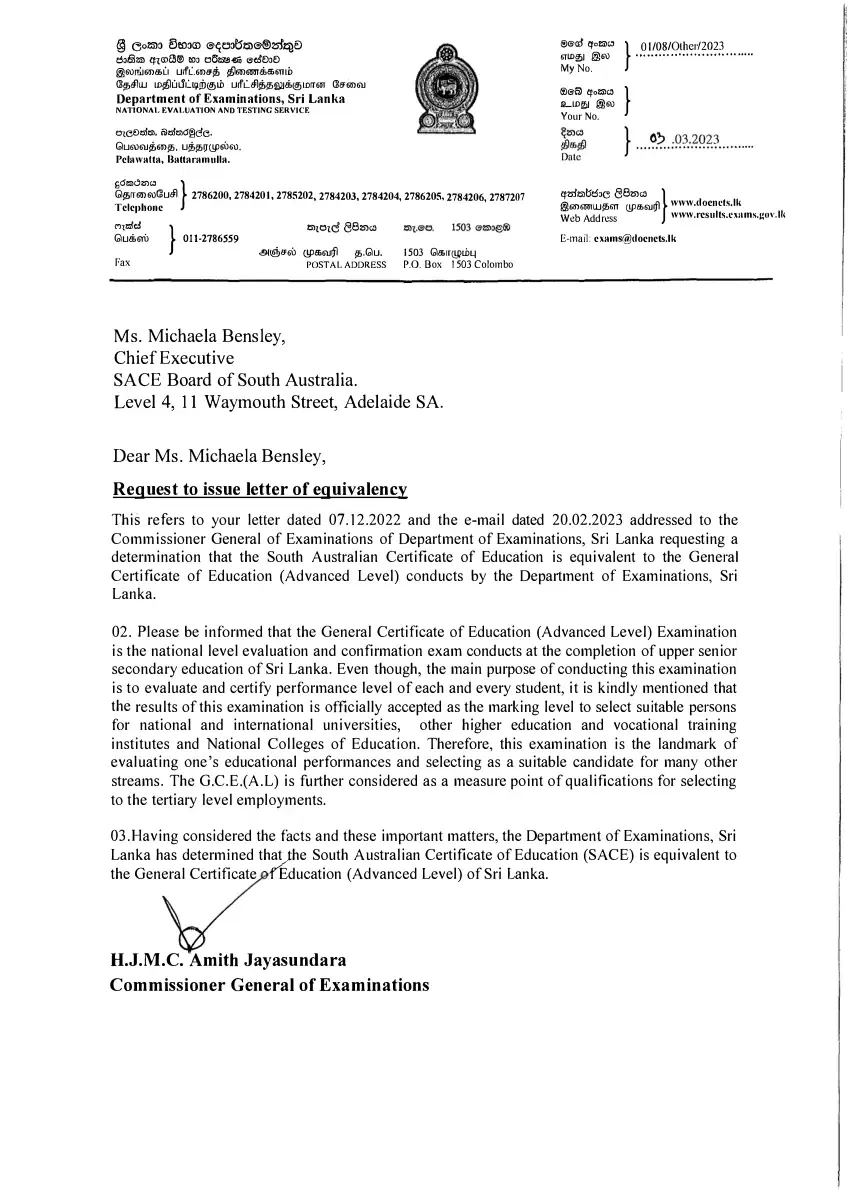
Department of Examinations, Sri Lanka
3 March 2023
The Ministry of Education, Department of Examinations has determined that the SACE is equivalent to the General Certificate of Education (Advanced Level) of Sri Lanka.
View and download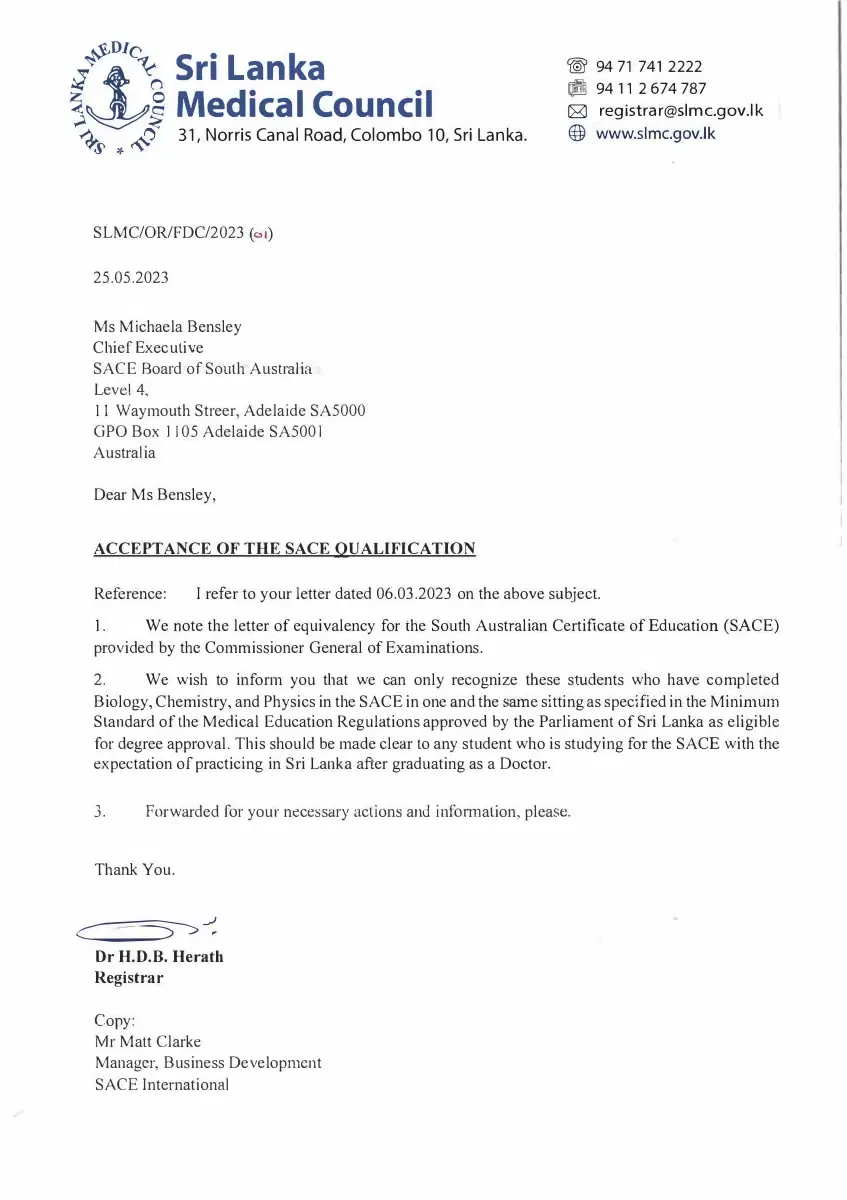
Sri Lanka Medical Council
25 May 2023
Students who complete Biology, Chemistry and Physics in the same sitting, as required by Sri Lanka's Medical Education Regulations, are eligible for degree approval. This matters for students planning to practise medicine in Sri Lanka after graduation.
View and download| Quality and accreditation | A-Levels | SACE |
|---|---|---|
| Recognised and accepted by universities worldwide | Yes | Yes |
| Government accredited curriculum | Yes | Yes |
| Proven history of graduate success | Yes | Yes |
| Two years' duration* | Yes | Yes |
* SACE duration can be shortened to 1 year with recognition of prior studies.
A-Levels
Multiple private companies including Pearson Edexcel, Cambridge and OxfordAQA Examinations.
SACE
SACE Board of South Australia, a South Australian Government agency.
A-Levels
Standardised tick box process.
SACE
Rigorous process that ensures alignment of the school's mission, education philosophy and values with the SACE Board's approach to foster a thriving learner.
A-Levels
Summative in nature, with prescriptive adherence to textbooks. The focus is on rote learning as students must remember facts and then repeat them at exam time.
SACE
A highly practical approach that allows teachers to use a wide range of resources and real-life scenarios to capture student's interests and better prepare them for life outside the classroom.
A-Levels
55+
SACE
100+
A-Levels
Students typically study three A-level subjects.
SACE
Students take a minimum of five subjects.
A-Levels
An international version of the A-Level is usually delivered outside the UK.
SACE
Students outside of Australia study the same curriculum as students in South Australia making them eligible to receive an ATAR just like all Australian students.
A-Levels
100% examination with multiple exams per subject. All exams are assessed externally. Assessment favours multiple choice or short answer questioning. It tests the student's ability to remember facts and uses a percentage grading system.
SACE
A standards-referenced assessment approach to ensure a comprehensive evaluation of students' application of knowledge and soft skills. Clear performance standards are outlined for each subject, facilitating targeted assessment. Ongoing evaluation involves a balanced mix of school and externally set assessments.
A-Levels
No.
SACE
First in the world to implement online electronic examinations.
A-Levels
This style of assessment has created an industry of exam practice/cramming centres for students to attend after-school to memorise facts for exams.
SACE
Not applicable.
A-Levels
Yes.
SACE
No. The final result is not fully dependent on exams. Ongoing assessments and feedback mean that students can improve their grades while they learn.
A-Levels
Focuses on knowledge preparation.
SACE
In addition to deep academic knowledge, students develop research skills, solve real-world problems and work in teams. They learn to think critically and are adaptable, forward-thinking and resilient, preparing them better for their university journey.
Discover more at sacei.edu.au.
Colombo International Campus
Typically replies within minutes
CIC Admissions
Hi there! How can we help you today?
 Start chat